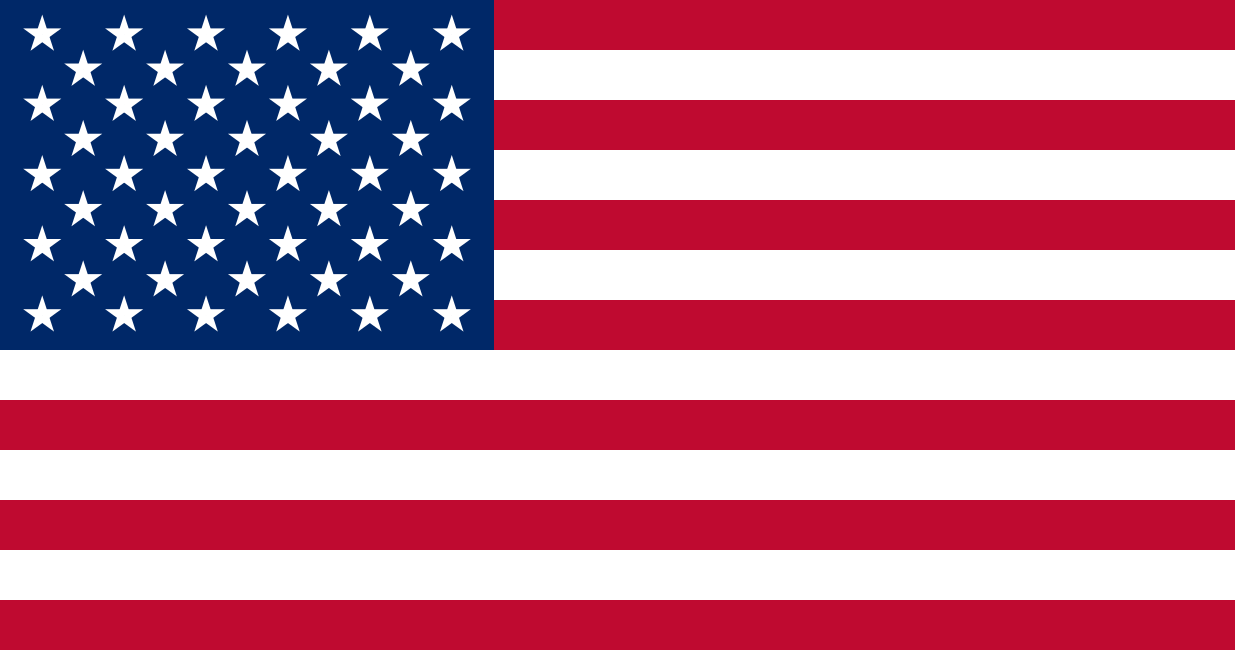
In the United States, at least if you are white, you can usually count on getting through airport security with a large tube of toothpaste, nail clippers, or other item that technically exceeds the official allowed limit but is also widely understood to be harmless. This is often true even if the security staff notice the item — I have personally stood and watched a TSA agent examine my obviously-too-large toothpaste tube looking for the size, then give up and say "well, it's half-empty anyway, it's fine."
This is, of course, not the case in Finland. While I suppose there is still a chance that something like a tube of toothpaste would not be noticed at airport security (though Helsinki airport security people have a much better track record for noticing), nobody will even think of giving it a pass if it is. I have lost such items as a cannister of shea butter that was a fraction of a milliliter over the limit before realizing that here, there really isn't any wiggle room in those sorts of rules.
In another example of the same overarching phenomenon, a surprising number of things in Finland still require showing a physical piece of paper to someone. In recent years, digitalization has replaced much of this, but if you are an immigrant it still comes up due to certain records not being officially on file. And even if the records are digitized, the process is still present, and there is more process in some aspects of life than Americans are used to.
At the same time, in the US, more things are proved by "I swear on pain of perjury" — i.e. we're not going to actually check, we're just going to make sure you know that we can hurt you if it later turns out that you lied.
When you start summing all of this up, you begin to notice something more profound: fundamentally, Finnish society runs on rules that people simply follow out of habit, even when they seem silly. People even talk about "sääntösuomi" (i.e. rules Finland) when grumbling about bureaucracy, but the number of people who would actually break a rule — even something small like crossing a street in the wrong place, and with no real risk of getting in trouble — remains small.
While there is overlap between this and the culture of obedience in Germany, I've found that the Finnish version is much less hierarchical. Finnish bureaucracy is less about the bureaucrat having power over you and more about both of you respecting the system of rules as a system. (And, as one of the few remaining full democracies in the world, Finns also justifiedly feel that they can influence and change that system via civic participation, as opposed to it being imposed from the outside.)
The United States, on the other hand, runs on what I have come to call simply bluster. Police, security, and other authority figures strive to appear as tough and threatening as possible, politicians want to be seen as "tough on crime", and the threat of serious consequences is constantly held up as a reason to do the thing. Meanwhile, actual enforcement often falls short, both in non-criminal situations like a TSA line and in cases of real crime. And that's before you bring racism and other forms of descrimination into it — a white person can get away with quite a few things that are Actually Illegal (tm) if they are good enough at sounding like an upstanding citizen.
It doesn't need to be said that this is probably one of the reasons for the United States' current problems with democracy, although both phenomena feed each other.
When I first moved here, the Finnish system sometimes felt constraining or invasive, but I have come to appreciate it in many ways. More than in the US, things actually work the way they say they do, and there are fewer situations where my neurodivergent brain is left wondering what I actually have to do after going through publicly-accessible instructions.
There is, in fact, a good reason for clear rules.